
Microneedling for Hair Loss: Can It Help With Thinning Hair?
Microneedling for hair loss has attracted attention as a non-surgical option for people concerned about thinning hair. The treatment uses very fine needles to create controlled micro-injuries in the scalp. This is intended to trigger a healing response and may also help certain topical treatments reach the scalp more effectively.
Research is promising, particularly for androgenetic alopecia, also called male or female pattern hair loss. However, microneedling is not a guaranteed cure, and it may not be appropriate for every cause of shedding or thinning. A professional assessment is important before deciding whether it belongs in your treatment plan.
What Is Scalp Microneedling?
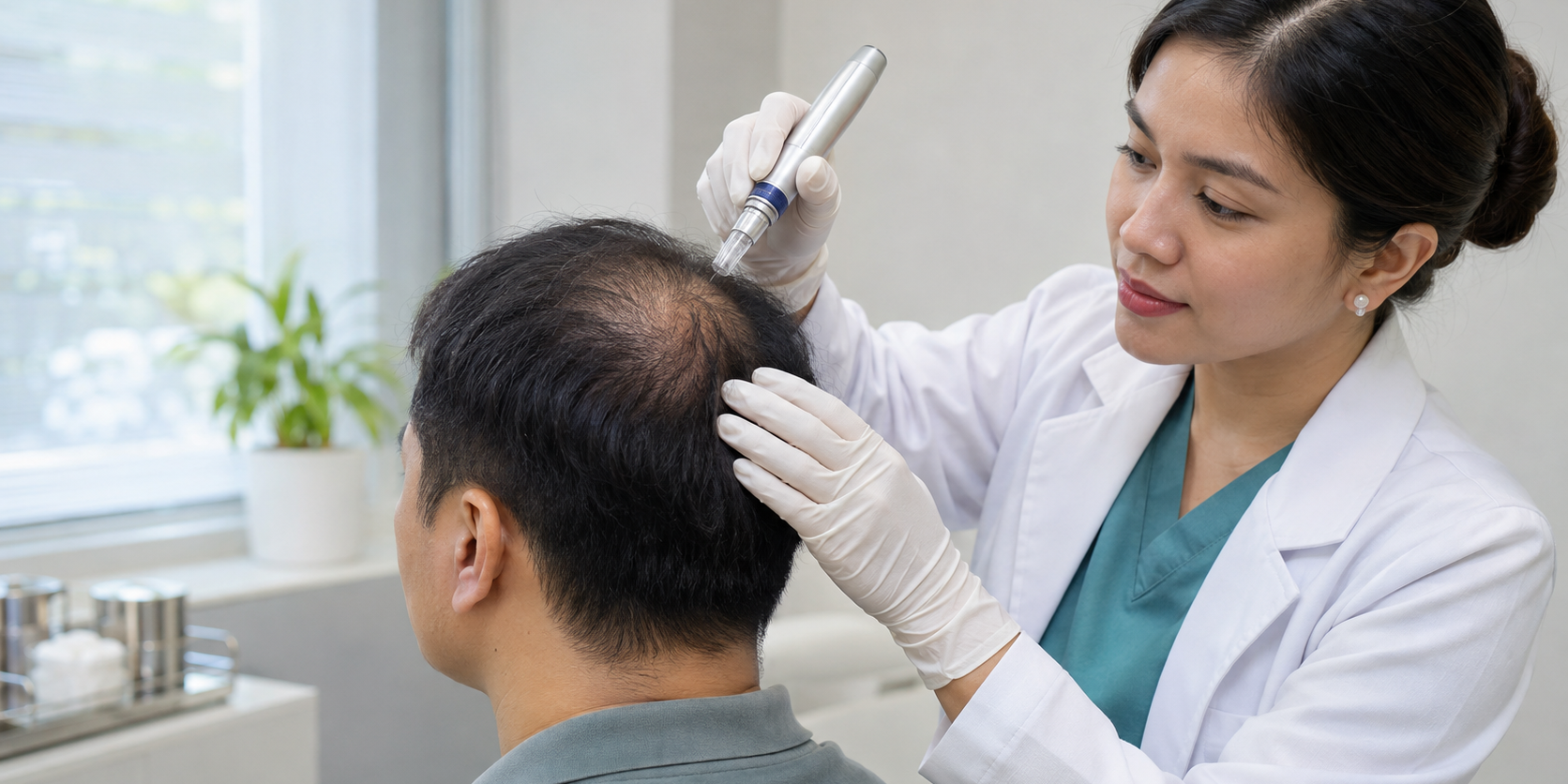
Scalp microneedling is a procedure in which a clinician passes a sterile device with small needles over selected areas of the scalp. The goal is to create a controlled response without causing excessive tissue injury. Professional devices may use a motorized pen or a rolling system, and treatment settings are chosen according to the patient’s scalp condition, hair-loss pattern, medical history, and overall plan.
A derma roller is a manual form of microneedling that is widely sold for home use. Although the basic idea is similar, professional scalp microneedling and home rolling are not interchangeable. Device quality, needle depth, hygiene, technique, treatment frequency, and the products placed on the scalp can all affect safety. Readers considering a roller can review MAXIM’s guide to derma rollers for hair growth, benefits, and risks.
How Might Microneedling Support Hair Growth?
Researchers are studying several possible mechanisms. The controlled micro-injuries may activate wound-healing signals in the skin, influence pathways involved in the hair-growth cycle, and increase temporary penetration of a topical medicine. These proposed effects do not mean that microneedling can revive every follicle or correct every underlying cause of hair loss.
The distinction matters because thinning hair can have many causes. Pattern hair loss, postpartum shedding, nutritional deficiency, thyroid disease, traction, inflammatory scalp disease, medication effects, and scarring alopecia require different approaches. Microneedling cannot replace a diagnosis.
What Does the Research Say?
The strongest published evidence concerns microneedling as an adjunct, especially when it is combined with topical minoxidil for androgenetic alopecia. A 2025 systematic review and meta-analysis of randomized trials found greater improvements in hair count and hair diameter with combined microneedling and minoxidil than with minoxidil alone. The studies varied considerably in their methods, however, and adverse events were somewhat more frequent in the combined-treatment groups, although they were generally described as mild or self-limiting.
An earlier systematic review also reported generally favorable findings across several hair-loss studies, but it emphasized that study quality was limited and protocols differed widely. The authors called for larger randomized trials to clarify the effect of microneedling by itself, the best treatment parameters, and long-term safety.
In practical terms, the evidence suggests that hair growth microneedling may be useful for selected patients as part of a broader plan. It does not establish one ideal device, depth, schedule, or combination for everyone. It also does not show that microneedling alone is superior to established medical treatments.
Who May Be a Candidate?
A clinician may discuss scalp microneedling with adults who have a confirmed diagnosis of androgenetic alopecia and still have active follicles in the thinning area. It may be considered when a patient is already using an appropriate topical treatment, has reached a plateau, or wants to discuss a professionally supervised non-surgical option.
Suitability depends on more than the appearance of thinning. A careful assessment may consider:
- The type, duration, and stability of hair loss
- Scalp health, including inflammation, infection, or scarring
- Current medicines and topical products
- Bleeding or healing problems
- Previous hair-restoration treatments
- The patient’s goals, tolerance for maintenance, and realistic expectations
MAXIM Hair Restoration – Philippines lists microneedling among its non-surgical options. Its hair-restoration overview also describes surgical and non-surgical services available for different concerns. The right starting point is an individualized assessment rather than choosing a device or treatment based only on online photos.
Possible Benefits and Important Limitations
Potential Benefits
- May improve hair-count or hair-diameter measures in some patients with pattern hair loss, particularly as an adjunct to minoxidil
- Can be performed without hair-transplant surgery
- May be incorporated into a broader plan that monitors hair density, shedding, and scalp health over time
Limitations
- Results vary, and visible improvement is not guaranteed
- The evidence is stronger for combination treatment than for microneedling alone
- Research protocols are inconsistent, so there is no universal treatment schedule
- It may not address the cause of sudden shedding, nutritional or hormonal problems, active scalp disease, or permanent scarring hair loss
- Maintenance or other treatment may still be needed
Risks and Side Effects
Temporary redness, tenderness, pinpoint bleeding, swelling, dryness, or flaking can occur after treatment. Poor technique or inadequate hygiene may increase the risk of infection, prolonged inflammation, pigment changes, folliculitis, or scarring. Applying an unsuitable product immediately after needling can also cause irritation or increase absorption beyond what was intended.
Microneedling may need to be postponed or avoided when there is an active scalp infection, open skin, uncontrolled inflammatory disease, a tendency to form abnormal scars, a bleeding disorder, or a medicine that affects healing or bleeding. These examples are not a complete screening list. Patients should disclose their health conditions, medicines, supplements, allergies, and previous procedures to the treating clinician.
Because risks depend on the person and the protocol, this article does not provide a needle depth or home treatment schedule. More aggressive treatment is not necessarily more effective, and it can increase harm.
What to Expect From a Professional Assessment
A useful consultation begins with the diagnosis. The clinical team may review when the hair loss started, where it is progressing, family history, recent illness or pregnancy, grooming practices, and current treatments. The scalp and donor areas can then be examined to determine whether the follicles appear active and whether another medical evaluation is needed.
If microneedling is appropriate, the clinician should explain the proposed device, infection-control measures, expected sensations, aftercare, treatment intervals, possible side effects, and how progress will be documented. Patients should also ask what outcome would count as meaningful improvement and when the plan will be reassessed.
Microneedling Compared With Other Hair-Restoration Options
Microneedling is one possible component of care, not a replacement for every other treatment. Topical or oral medicines may be recommended for pattern hair loss after medical review. Platelet-rich plasma therapy is another non-surgical option that uses a patient’s processed blood components and follows a different protocol. Evidence, cost, maintenance, and suitability should be discussed separately for each treatment.
Hair transplantation, including FUE or FUT, moves suitable donor follicles into areas of loss. It is a surgical option for selected patients with an adequate donor supply and a stable, appropriate pattern of hair loss. Microneedling does not create new donor follicles and should not be presented as an equivalent substitute for transplantation when surgery is clinically indicated.
Frequently Asked Questions
Can Microneedling Regrow Hair on a Bald Area?
It depends on why the area is bald and whether functioning follicles remain. Microneedling cannot be expected to restore follicles destroyed by scarring or to correct an untreated medical cause. An examination is needed before estimating what may be possible.
Does Microneedling Work Without Minoxidil?
Some studies have examined microneedling alone, but the more consistent evidence is for its use as an adjunct to another treatment, especially topical minoxidil in androgenetic alopecia. A clinician can explain whether minoxidil is appropriate and how it should be timed around a procedure.
How Soon Can Results Appear?
Hair grows slowly, so evaluation generally requires consistent follow-up over months rather than days or weeks. Photos or standardized measurements may help track change. Individual timelines differ, and a lack of immediate visible growth does not justify increasing treatment intensity without medical advice.
Is At-Home Microneedling Safe?
Home devices carry risks related to sterilization, technique, needle quality, repeated use, and the application of topical products. People with scalp disease, health conditions, or medicines that affect healing should seek medical advice first. Professional guidance is the safer way to decide whether the treatment is suitable.
Discuss Your Hair-Loss Treatment Options
Microneedling for hair loss may support selected patients with thinning hair, especially as part of a professionally supervised plan for pattern hair loss. The current evidence is encouraging but still evolving, and results depend on the diagnosis, the condition of the follicles, and the rest of the treatment plan.
To review your hair-loss pattern and discuss surgical and non-surgical options in Makati or Mandaue City, request a professional consultation with MAXIM Hair Restoration – Philippines. A consultation can help clarify what is causing the thinning, whether microneedling is appropriate, and what realistic next steps may look like.
Medical References
- 2025 systematic review and meta-analysis of microneedling plus minoxidil for androgenetic alopecia
- Systematic review of microneedling in hair-loss disorders
This article is for general education and does not replace diagnosis or treatment by a qualified medical professional.